You may be looking for a “long battery life GPS tracker,” and may have come across a few GPS trackers with specifications like “up to 180 days standby” appearing on product listings, yet reviews from many owners find their devices draining far faster than expected. So if you are confused, then when you started on this research, don’t worry, we have a guide that breaks down exactly what determines how long a GPS tracker battery lasts, what the engineering research says, and how to apply that knowledge when choosing between a battery-powered tracker like the Salind GPS 20
Key Takeaways
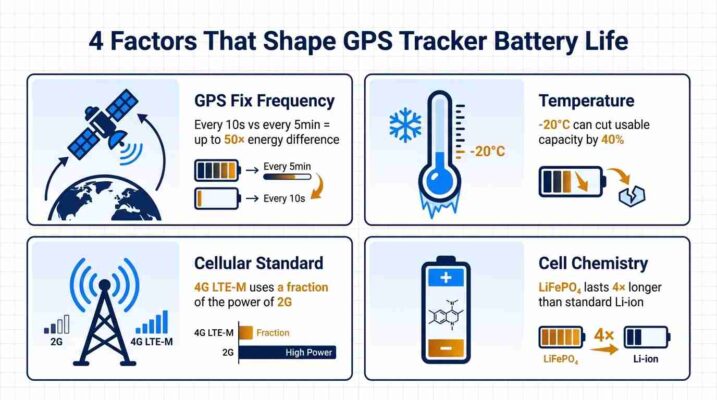
GPS fix frequency is the single biggest lever on battery consumption — a tracker reporting every 10 seconds can use up to 50× more energy per day than one reporting every 5 minutes.
Battery chemistry directly determines long-term capacity retention; lithium iron phosphate (LiFePO₄) cells outlast standard Li-ion by a factor of 4× in cycle life.
Cold temperatures below 0 °C can cut usable battery capacity by up to 40%, which matters significantly for vehicle and luggage trackers used outdoors in winter.
Modern 4G LTE-M cellular radios consume orders of magnitude less power than legacy 2G modems during data transmission.
Motion-triggered sleep modes — where the tracker goes dormant when stationary — are the most practical engineering tool for extending standby life in car, fleet, and asset trackers.
1. Battery Chemistry: Why Capacity Numbers Do Not Tell the Full Story
The foundation of every GPS tracker’s endurance is the electrochemical cell inside it. Most consumer-grade trackers use lithium-ion (Li-ion) or lithium polymer (LiPo) cells because they pack a high amount of energy into a small, light enclosure. However, these chemistries share a well-documented weakness: capacity fade over time. Studies published in the Journal of The Electrochemical Society show that Li-ion cells lose roughly 15–25% of their original capacity after 300–500 charge cycles under normal operating conditions, and that degradation accelerates when cells are routinely discharged below 20% or stored at elevated temperatures.
This is directly relevant to battery-powered GPS trackers used in demanding real-world scenarios — think a Salind tracker clipped to a dog’s collar and recharged weekly, or a fleet asset tracker mounted inside a trailer that spends summer months in direct sun. In both cases, the battery the device ships with on day one will behave meaningfully differently after 18 months of use.
A growing segment of the industry is moving toward lithium iron phosphate (LiFePO₄) chemistry for long-life applications. LiFePO₄ cells are chemically more stable, handle wider temperature swings, and retain over 80% of original capacity after 2,000+ charge cycles — roughly four times the cycle durability of standard Li-ion. The trade-off is lower energy density, meaning a LiFePO₄ device of the same physical size holds less total energy on paper. For trackers that are charged regularly and deployed over years, however, the slower degradation curve easily compensates for that difference.
2. GPS Fix Frequency: The Biggest Battery Variable You Can Actually Control
Many buyers assume the cellular radio is the main battery drain in a GPS tracker. In practice, the GNSS receiver — the chip responsible for acquiring satellite signals and computing a location fix — is typically the dominant energy consumer during active use. A cold-start GPS acquisition, where the device has no prior satellite almanac cached, can draw 25–30 mA for up to 60 seconds. A warm-start fix, where recent almanac data is already stored on the chip, reduces that window to under 5 seconds at a similar current level. The energy difference per fix is substantial.
Research from the IEEE Transactions on Mobile Computing quantifies the effect clearly: a device polling GPS every 10 seconds consumes approximately 50× more energy per day than one polling every 5 minutes, assuming comparable fix quality. This is the engineering reality behind the extended battery modes found in trackers like the Salind GPS 20, which advertises up to 180 days of battery life. That figure is not marketing hyperbole — it reflects a genuinely reduced GNSS sampling rate in low-activity conditions, combined with motion-triggered wake-up logic that resumes frequent reporting only when the device detects movement.
Assisted GPS (A-GPS), which downloads satellite almanac data from the cellular network rather than rebuilding it from scratch over the air, further reduces cold-start time and energy cost by as much as 90% according to chip-level benchmarks from GNSS module manufacturer u-blox. All current Salind 4G trackers use A-GPS, which is one reason they acquire a position fix faster and more efficiently than older-generation 2G devices. For practical guidance on matching update intervals to different use cases — car tracking versus fleet versus luggage — see the Salind fleet tracking overview.
3. Temperature Effects: The Hidden Battery Drain Hiding in Plain Sight
Battery performance is acutely sensitive to ambient temperature, a relationship governed by the Arrhenius equation, which describes how chemical reaction rates slow at lower temperatures. At 20 °C (68 °F), a lithium-ion cell delivers close to its rated capacity. At 0 °C (32 °F), usable capacity drops by roughly 20%. At -20 °C (-4 °F) — common in overnight outdoor conditions during a northern winter, or inside an unheated cargo container — capacity can fall by 35–40%, according to data published by Sandia National Laboratories in their assessment of lithium battery performance for field applications.
For Salind customers, this has concrete implications. A luggage tracker packed in the hold of a transatlantic flight, where cargo temperatures can fall below -20 °C, may arrive with noticeably less battery remaining than expected even if no location reporting occurred during the journey. Similarly, a dog tracker left in an unheated vehicle overnight in winter will wake up to a shorter effective range than it had the evening before. The battery has not been damaged — it simply delivers less energy at low temperatures, and recovers as it warms up.
High temperatures create a different problem: permanent, accelerated chemical degradation. Research from battery scientists at Stanford University found that sustained storage at 60 °C reduces Li-ion cell life by a factor of roughly 4× compared to storage at 25 °C. A tracker mounted on a car dashboard or inside a dark vehicle interior during summer in Texas or Arizona can easily reach 60–70 °C. This explains the common pattern of a tracker working well through its first winter and then struggling to hold a charge by the following summer. Placement in a shaded, ventilated location — under the vehicle chassis rather than on a sun-facing dash mount — meaningfully extends the working life of the battery.
4. 4G vs. 2G: Why the Cellular Standard Matters More Than Most People Realise
The second-largest power consumer in a connected GPS tracker is the cellular modem used to transmit location data. Legacy 2G (GPRS/GSM) modems transmit data in bursts drawing 500–800 mA at peak. This was the industry standard for a decade, and many older trackers still use it. The shift to IoT-optimised 4G standards has been one of the most significant advances in tracker hardware over the past several years, and it is the reason Salind moved its entire product lineup to 4G.
LTE-M (Cat-M1), the 4G standard used in Salind’s current devices, was designed by 3GPP specifically for low-power wide-area IoT applications. It supports a feature called Power Saving Mode (PSM), which allows the modem to enter a deep sleep state between transmissions while retaining its network registration — drawing under 5 µA in that idle state, versus hundreds of milliamps during 2G transmission. An independent benchmarking study from Ericsson Research demonstrated that LTE-M devices using PSM can achieve battery life exceeding 10 years in very low-frequency reporting scenarios using a standard 5 Wh cell. While that extreme figure applies to industrial sensors rather than real-time GPS trackers, the underlying efficiency gain carries through to every device using the standard.
For Salind customers, the practical consequence is straightforward: a 4G Salind tracker will last significantly longer on the same battery than an equivalent 2G device, even with identical reporting intervals. This is especially relevant for fleet operators running large numbers of vehicles where recharging logistics are a real operational consideration. Beyond battery life, 2G networks are being decommissioned across North America and Europe, making the move to 4G a matter of future-proofing as well as efficiency. You can browse Salind’s current 4G range at the Salind shop.
The four engineering variables that determine real-world GPS tracker battery life, based on published research.
What This Means in Everyday Use: Matching the Right Tracker to Your Situation
Translating laboratory findings into real purchasing decisions is where most technical guides fall short. Here is what the science means for the most common Salind use cases.
Car and motorcycle tracking. If your primary concern is theft recovery, you do not need a live 10-second update interval — the vehicle is either where you left it or it is not. A Salind tracker set to report every few minutes while stationary and more frequently when movement is detected will last many times longer than one running at maximum polling rate. The Salind 11’s 70-day battery life is a realistic figure under these conditions. If you want to eliminate battery management entirely, the Salind 01, which connects permanently to the vehicle’s 12V electrical system, removes the variable altogether.
Fleet tracking. Fleet operators typically need higher reporting frequencies during working hours and minimal activity overnight. Configuring trackers to enter deep sleep outside operational hours, and deploying hardwired or OBD-port devices like the Salind 08 in vehicles that are used daily, significantly reduces maintenance overhead and extends battery life across a large fleet. Temperature management at the fleet level — ensuring trackers are not stored in conditions below 0 °C during recharging — prevents the lithium plating damage that permanently degrades cells after cold-temperature charging cycles.
Dog tracking. A dog tracker is recharged frequently and operates in highly variable conditions — cold mornings, hot afternoons, rain. The key variable here is update frequency during an active walk versus overnight standby. Setting a Salind tracker to report at longer intervals when the dog is home and shorter intervals when out significantly extends the charge between recharges. Avoiding leaving the tracker on a warm radiator or windowsill to charge also protects the cell from the high-temperature degradation described above.
Luggage and asset tracking. These are the scenarios where low reporting frequency matters most. A suitcase tracker that pings once every 30 minutes is entirely sufficient for monitoring luggage in transit, and will comfortably outlast a multi-week trip on a single charge. For long-term asset deployment — a trailer, a container, construction equipment — the LTE-M sleep mode capabilities of Salind’s 4G hardware make multi-month battery life genuinely achievable, not just theoretical.
Conclusion
GPS tracker battery life in 2026 is not a lottery, and it is not purely a matter of how large the battery pack is. It is the predictable result of four interacting variables: the energy cost of each GPS fix and how frequently fixes are taken, the chemistry and condition of the battery cell, the ambient temperatures the device operates in, and the efficiency of the cellular radio standard used to transmit data. Understanding these factors allows you to look past headline figures, configure your device intelligently, and choose the right form factor for your use case — whether that is a battery-powered tracker like the Salind GPS 20 for long-term deployments, or a hardwired solution that removes battery management from the equation entirely. Explore the full Salind range at salind-gps.com.
Scientific Sources
Xu, B. et al. (2016). “Cycle performance of LiFePO₄ batteries under different charge/discharge rates.” Journal of The Electrochemical Society, 163(9), A2272–A2279.
Rao, R. et al. (2005). “Reduced Power Consumption for GPS-Based Location Tracking.” IEEE Transactions on Mobile Computing, 4(6), 626–636.
u-blox AG (2022). A-GPS and AssistNow: Performance White Paper. Thalwil, Switzerland: u-blox.
Waldmann, T. et al. (2014). “Temperature dependent ageing mechanisms in Lithium-ion batteries.” Journal of Power Sources, 262, 129–135. DOI: 10.1016/j.jpowsour.2014.03.112
Sandia National Laboratories (2015). Lithium-Ion Battery Safety Issues for Electric and Plug-in Hybrid Vehicles. SAND2015. Albuquerque, NM.
Ericsson Research (2018). Cellular IoT Power Consumption: A Guide for Device Designers. Stockholm: Ericsson AB.
3GPP TS 23.682 (2019). “Architecture enhancements to facilitate communications with packet data networks and applications.” Release 16.
To provide the best experiences, we use technologies like cookies to store and/or access device information. Consenting to these technologies will allow us to process data such as browsing behavior or unique IDs on this site. Not consenting or withdrawing consent, may adversely affect certain features and functions.
Functional
Always active
The technical storage or access is strictly necessary for the legitimate purpose of enabling the use of a specific service explicitly requested by the subscriber or user, or for the sole purpose of carrying out the transmission of a communication over an electronic communications network.
Preferences
The technical storage or access is necessary for the legitimate purpose of storing preferences that are not requested by the subscriber or user.
Statistics
The technical storage or access that is used exclusively for statistical purposes.The technical storage or access that is used exclusively for anonymous statistical purposes. Without a subpoena, voluntary compliance on the part of your Internet Service Provider, or additional records from a third party, information stored or retrieved for this purpose alone cannot usually be used to identify you.
Marketing
The technical storage or access is required to create user profiles to send advertising, or to track the user on a website or across several websites for similar marketing purposes.
To provide the best experiences, we use technologies like cookies to store and/or access device information. Consenting to these technologies will allow us to process data such as browsing behavior or unique IDs on this site. Not consenting or withdrawing consent, may adversely affect certain features and functions.
Functional
Always active
The technical storage or access is strictly necessary for the legitimate purpose of enabling the use of a specific service explicitly requested by the subscriber or user, or for the sole purpose of carrying out the transmission of a communication over an electronic communications network.
Preferences
The technical storage or access is necessary for the legitimate purpose of storing preferences that are not requested by the subscriber or user.
Statistics
The technical storage or access that is used exclusively for statistical purposes.The technical storage or access that is used exclusively for anonymous statistical purposes. Without a subpoena, voluntary compliance on the part of your Internet Service Provider, or additional records from a third party, information stored or retrieved for this purpose alone cannot usually be used to identify you.
Marketing
The technical storage or access is required to create user profiles to send advertising, or to track the user on a website or across several websites for similar marketing purposes.


 DE
DE
 FR
FR
 ES
ES
 IT
IT
 BR
BR
 PT
PT
 USA
USA