

 DE
DE
 FR
FR
 ES
ES
 IT
IT
 BR
BR
 PT
PT
 USA
USA
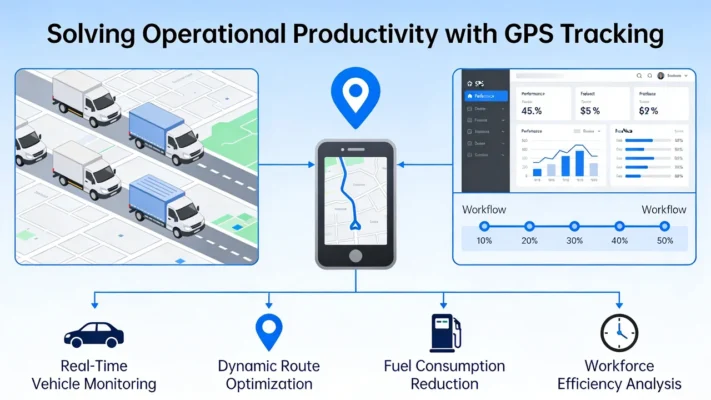
Every minute a vehicle idles unnecessarily, every detour a driver takes without reason, and every piece of equipment that goes missing represents money quietly draining from your business. For companies that depend on mobile workforces, fleets, or field operations, these inefficiencies don’t just sting — they compound.
GPS tracking has evolved far beyond a simple “where is my truck?” tool. Today’s systems are comprehensive operational platforms that give business owners and managers real-time visibility across their entire operation, from driver behavior and fuel consumption to asset location and predictive maintenance. According to industry research, businesses that implement GPS tracking report an average 22% reduction in fuel costs and 75% report measurable improvements in productivity and efficiency.
This article breaks down exactly how GPS tracking solves the productivity challenges that cost businesses the most, and what it means for your bottom line.
1. Real-Time Fleet Visibility: Know What’s Happening, Right Now
The foundation of operational productivity is awareness. When you don’t know where your vehicles are, what condition they’re in, or how your drivers are behaving, every operational decision you make is a guess.
GPS tracking eliminates that guesswork. From a single dashboard, managers can view the live location of every vehicle in the fleet, monitor speed and route adherence, and receive instant alerts if anything deviates from plan. This level of visibility alone enables faster, smarter dispatching — getting the nearest available resource to the right job without delays or back-and-forth phone calls.
For field service companies and logistics operations, real-time tracking also creates a feedback loop that continuously improves operations. You stop reacting to problems and start anticipating them.
GPS Tracker without sim- does it work?
2. Route Optimization: Every Mile Matters
Inefficient routing is one of the most common and most fixable sources of wasted time and fuel. Without data, drivers often rely on habit, guesswork, or outdated information to plan their routes. The result is unnecessary mileage, missed delivery windows, and frustrated customers.
Modern GPS systems analyze real-time traffic conditions, road closures, historical patterns, and job priorities to recommend the most efficient routes automatically. For businesses handling multiple daily deliveries or service calls, even a 10% reduction in average route length compounds into significant savings over a year.
Beyond fuel savings, optimized routing means more jobs completed per day without adding vehicles or headcount, a direct multiplier on your existing capacity.
3. Driver Behavior Monitoring: Safety, Savings, and Accountability
How your drivers behave on the road has a direct impact on fuel costs, vehicle wear, accident risk, and insurance premiums. Harsh braking, rapid acceleration, speeding, and excessive idling all add up financially and operationally.
GPS tracking captures this data continuously and surfaces it in easy-to-read reports. Managers can identify patterns, initiate coaching conversations backed by facts rather than anecdotes, and track improvement over time.
The financial case is compelling: insurance carriers increasingly offer premium discounts of 15–30% for fleets that actively monitor and manage driver behavior. For a company spending several hundred thousand dollars annually on fleet insurance, that translates to real, recurring savings. Combine that with reduced accident rates which GPS-tracked fleets typically see improve by up to 25% and the ROI becomes difficult to ignore.
4. Gamifying Driver Performance: Make Safety a Culture, Not a Mandate
Tracking driver behavior doesn’t have to feel punitive. In fact, the most effective programs flip the model entirely using GPS data to recognize and reward top-performing drivers rather than only flagging problems.
By building a performance scoring system around metrics like fuel-efficient driving, minimal idling, smooth braking, and on-time arrivals, companies can create friendly competition among their drivers. Tangible rewards, bonuses, recognition, extra days off, reinforce safe habits far more effectively than disciplinary action alone.
A fleet of 50 vehicles running a well-designed driver incentive program can expect to see fuel consumption drop by 10–15% annually, with reduced wear and maintenance costs following close behind.
5. Proactive and Predictive Maintenance: Stop Fixing, Start Preventing
Reactive maintenance is expensive. A driver reports a strange noise, the vehicle is already in distress, and now you’re dealing with an emergency repair, possible towing costs, and a gap in your schedule that ripples through the day’s operations.
GPS systems equipped with engine diagnostics reporting change that equation. By monitoring engine hours, diagnostic trouble codes, and system health indicators in real time, these platforms can alert you to developing issues before they become breakdowns. Businesses that take advantage of this capability reduce unscheduled downtime by up to 50%.
For a fleet of 100 vehicles, the downstream savings from avoided emergency repairs and lost productivity can exceed $200,000 annually. Beyond emergencies, predictive analytics can also schedule routine maintenance during off-peak hours, keeping vehicles in top condition without disrupting operations.
6. Cutting Idle Time: A Quick Win with Big Returns
Excessive idling is one of the most overlooked sources of waste in fleet operations. Engines running while drivers wait, take breaks, or simply forget to shut off cost fuel, accelerate engine wear, and in many jurisdictions carry regulatory implications.
GPS tracking makes idle time visible. Once visible, it becomes manageable. Reports highlight which vehicles idle the most, during which hours, and in which locations — giving managers the data they need to set policies, train drivers, and track compliance.
Research from the Environmental Defense Fund found that cutting just 30 minutes of daily idling per vehicle saves approximately $400 per vehicle annually. For a 100-vehicle fleet, that’s $40,000 per year — with zero capital investment beyond the tracking system already in place.
7. Asset Utilization: Getting More from What You Already Own
Not every productivity problem requires buying more equipment. Often, businesses already own underutilized assets — vehicles sitting parked when they could be out generating revenue, or equipment deployed in the wrong location.
GPS asset tracking brings utilization reporting into focus. Managers can see which assets are idle, which are overworked, and how workload could be redistributed more effectively across the fleet. This data reduces the pressure to purchase additional equipment and extends the working life of assets already on hand,a significant capital expense avoidance over time.
Asset tracking also addresses theft. Real-time location data means stolen vehicles or equipment can be recovered quickly, and geofencing alerts notify managers the moment an asset leaves an authorized zone.
8. Improved Customer Service: Deliver on Your Promises
Every operational improvement from GPS tracking ultimately shows up in the customer experience. Faster routing means earlier arrivals. Real-time visibility means accurate ETAs. Proactive maintenance means fewer missed appointments due to vehicle breakdowns.
In service industries, the ability to give customers a precise arrival window, and actually hit it is a meaningful differentiator. Research consistently shows that companies with high customer satisfaction grow revenue 4–8% faster than competitors with lower scores. Operational reliability, enabled by GPS tracking, is one of the most straightforward ways to earn that loyalty.
9. Employee Accountability and Morale: Transparency That Works Both Ways
GPS tracking sometimes raises concerns among employees about surveillance. But when implemented thoughtfully, it can actually improve morale rather than damage it.
Transparency works both ways. Employees who know their performance is tracked fairly and that the same data that identifies problems also highlights top performance — tend to feel more valued, not less. Clear, data-backed conversations replace subjective evaluations. High performers get recognized. Problems get addressed constructively.
The result is a more engaged workforce, lower turnover, and a culture of accountability that benefits everyone.
10. Choosing the Right GPS Tracking System
Not all GPS tracking platforms are built the same. When evaluating options for your business, consider:
Accuracy and reliability — Real-time updates and precise location data are non-negotiable for effective fleet management.
Ease of use — The best system in the world does nothing if managers don’t use it. Look for intuitive dashboards and mobile access.
Customization and integration — Your GPS platform should plug into your existing dispatch, scheduling, and maintenance workflows, not operate in isolation.
Scalability — Choose a system that grows with you. Adding vehicles or assets should be seamless.
Cost-effectiveness — Evaluate total cost of ownership, including hardware, subscription fees, and implementation — against the operational savings you expect to achieve.
Implementation: Making It Work
Deploying a GPS tracking system is only half the job. Making it deliver results requires deliberate implementation:
Set clear goals. Define what success looks like before you start — whether that’s a target reduction in fuel costs, faster response times, or improved delivery accuracy.
Communicate with your team. Employees should understand why GPS tracking is being implemented, how the data will be used, and what’s in it for them. Transparency builds trust.
Train thoroughly. Ensure managers and dispatchers know how to interpret reports and act on the data, not just view it.
Review and adapt. GPS data is only valuable if someone is using it. Build regular review cycles into your operations to identify trends and continuously refine your approach.